فارسی
Start Farsi today, free.
34 lessons, 2,900+ practice questions in the full course, 400+ of them free, and 300+ words, each taught the way it is written and the way people say it, with audio on both. The first lessons are free with your email; the rest unlocks for founding members.
Start free lessons Or go straight to the ebook and flashcardsPersonal
Why I learned Farsi.
Farsi is personal in a way the other languages are not. It is the language of my heritage, and for most of my childhood I treated it carelessly. My Farsi was broken, my accent thick, and when my mother pushed me to learn the script I resisted it completely.
"Much did I suffer during these thirty years, but I revived the Iranian identity through this Persian tongue."
Ferdowsi
Something changed at fifteen. I sat down and learned the entire script in three days. After that the language opened up faster than I expected. I moved through it with a speed that surprised even me, and shortly after I turned toward Arabic. Modern Farsi has a lot of Arabic vocabulary, so naturally I got adjusted to Arabic.
Ferdowsi wrote: 'Much did I suffer during these thirty years, but I revived the Iranian identity through this Persian tongue.' I did not suffer thirty years. But I understand, in my own small way, what it means to return to a language and find something of yourself waiting there.
Mahdi's Guide: Teach Yourself Farsi

Farsi was my first language and I still could not read a word of it. This guide is the exact path I took: the script in three days, the habits that made it stick, and the Arabic overlap nobody teaches you to use. Written for two readers at once, heritage speakers who can talk but not read, and complete beginners starting from zero.
- The full alphabet, letter by letter, in all four positional forms
- The script demystified: you'll be reading in days, not months
- Why four letters all sound like z, and how that becomes your advantage
- Why Farsi grammar is secretly one of the easiest to grasp: no gender, simple plurals
- Bonus: 25 AI prompts, a 30-day roadmap, and an Arabic-Farsi loanword cheat sheet
PDF · Instant download · Works for complete beginners
Farsi: 1000 Most Common Words
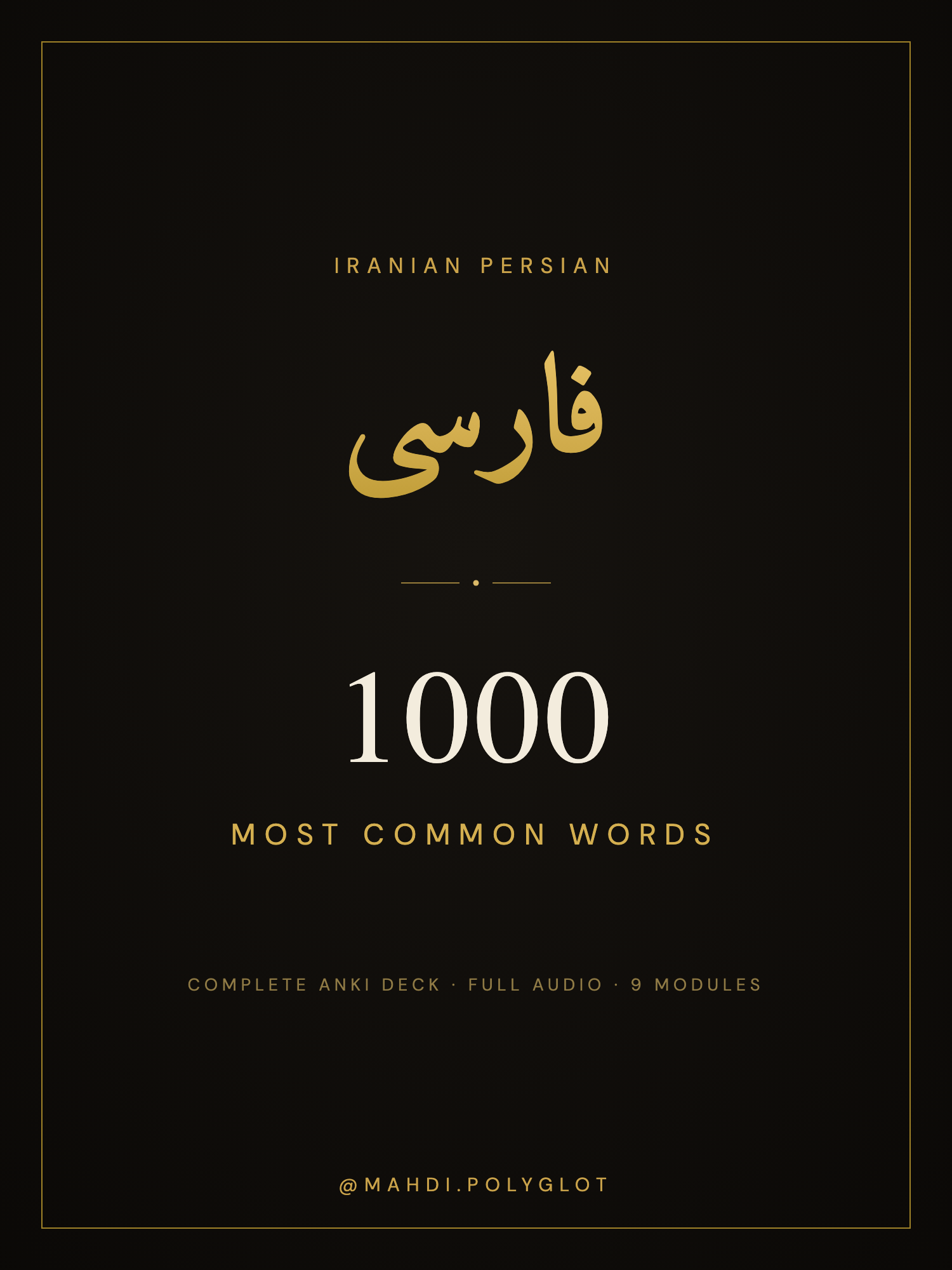
The 1,000 most common words in Farsi, built into a complete Anki deck with audio. Every card gives you the word in Persian script with a clear romanization so you always know how to pronounce it, the English meaning, and a natural example sentence.
- 1,000 words drawn from frequency lists, so you learn what matters first
- Persian script, romanization, meaning, and an example sentence on every card
- Native-quality audio for every word and every sentence
- Nouns with their plurals, verbs with infinitive and present forms
- 9 modules, from greetings and basics to advanced formal Farsi
Anki deck (.apkg) · Instant download · Full audio · Works on Mac, Windows, iPhone & Android
Try Before You Buy
See how the cards work.
Flip through five real cards from the Farsi deck, with audio. This is exactly what you study.
The Language
An Indo-European language in an Arabic script.
Farsi, also called Persian, is spoken in Iran, Afghanistan (as Dari), and Tajikistan (as Tajik). It uses a modified Arabic script but is a completely different language family: Indo-European, not Semitic. If you've studied Arabic, the script is familiar, but the grammar and vocabulary are entirely different.
Farsi has influenced English more than most people realize. The word paradise comes from the Persian firdaus. Checkmate comes from shah mat, meaning the king is dead. Pajamas, bazaar, caravan, jasmine, all Persian in origin. The language is woven into English in places nobody thinks to look.
The grammar is relatively straightforward compared to Arabic, with no grammatical gender, no case system in the complex Latin sense, and a consistent verb conjugation pattern. The script takes time to learn, but it's beautiful, and once mastered, opens up an entire literary world.
Culture & Civilization
The civilization that produced Rumi.
Out beyond ideas of wrongdoing and rightdoing,
there is a field. I'll meet you there.
Rumi, 13th century (translated from Farsi)
Persian poetry is one of humanity's greatest achievements. Rumi, Hafez, Omar Khayyam, and Ferdowsi are not just literary figures; they are cultural pillars whose work has shaped how millions of people understand love, loss, God, and time. Reading them in the original Farsi is a completely different experience from reading them in translation.
The Persian Empire, at its height, was the largest empire the world had known. Cyrus the Great's Achaemenid dynasty introduced concepts of human rights and religious tolerance that were radical for their time. The ruins at Persepolis are a testament to a civilization of extraordinary sophistication.
Persian art and architecture (the mosques of Isfahan, the miniature paintings, the intricate tilework) are among the most beautiful things humans have ever made. Persian cuisine, too, is extraordinary: the balance of sweet, sour, and savory; the use of herbs, dried fruits, and saffron in ways that feel both ancient and endlessly inventive.
Difficulty
Hard, but deeply worth it.
The FSI rates Farsi as Category 4 alongside Arabic, roughly 2,200 hours to professional proficiency for English speakers. The script, the sounds, and the cultural distance all contribute to that rating.
But here's what the rating doesn't tell you: Farsi grammar is actually quite learnable. There's no grammatical gender. The verb system, while complex, is regular and logical. The biggest challenges are the script (shared with Arabic but with some different letters and sounds) and the vocabulary, which has very few cognates with English.
What the FSI rating definitely doesn't capture is the return on investment. Farsi unlocks a civilization, a literature, and a way of seeing the world that is genuinely unlike anything available in European languages. For me, it was worth every hour.